

European University Institute, Florence, 9–10 June 2025
Session 1: The Global Assault on the Liberal World Order
Question 1: Is the decline of the liberal order an inevitable consequence of its own contradictions?
In the institutional systems of nation-states, the liberal political order is founded on the principle of limiting all forms of power and their diffusion of political power across several institutions, thereby ensuring the protection of individual and group freedoms. The way in which this is achieved is through the rule of law and the separation of powers (sometimes referred to as “checks-and-balances”). Central to this liberal vision within the boundaries of the sovereign state is the idea that no actor, not even majoritarian forces, stands above the law. The vision does not deny conflict, but rules allow for the pacification and routinization of conflict.
The liberal arrangement creates a systemic tension – not necessarily a “contradiction” – that shows in many ways. One is the combination of majoritarian with non-majoritarian institutions (the latter being defined as not accountable to electoral majorities and institutions issued from such majorities).[1] Furthermore, liberal democracy emphasizes representative government as opposed to direct democracy.[2] Among other things, elected officials act as trustees rather than delegates of the popular will and the early thinkers and drafters of liberal constitutions in the 19th century (Burke 1774, Madison 1787, Siéyès 1789) dismissed the idea of the “imperative mandate” (Pitkin 1967, Manin 1997). The tension, then, resides in the fact that this arrangement to limit “democracy” appears elitist, as it needs to exclude and restrict participation. In trying to combine inclusion and effective policy, representative government needs to create unequal participation, where (for example) opinions count differently based on competence. Historical patterns show that such tensions are not new; they emerged after World War I and have resurfaced in recent times with the twin challenge to representative democracy coming from both populist and technocratic actors (Urbinati 2006, Caramani 2017).
The tension reflects a broader challenge: the attempt to reconcile mass participation (a product of the National Revolution – the inclusion of the bourgeoisie and later of peasants and workers) with the efficiency demanded by state institutions (a legacy of the Industrial Revolution – the exclusion of the masses deprived of competence and time to address complex state matters, but also the ideal of running society like a “machine” based on statistics and scientific methods).[3] The attempt at such a reconciliation of opposite goal has consequently always been fragile. While not inherently contradictory, the liberal order’s mechanisms are unstable and open to continuous contestation. Challenges emerge from those who demand either expanded participation or greater exclusion in the name of effective governance. The difficulty lies in managing this inherent instability while maintaining the legitimacy of the system (Scharpf 1999, Mair, 2013, Caramani 2020).
How that this affect the liberal world order? The liberal democratic order is historically rooted in the West and reflects Western institutional arrangements at the level of national institutions and their normative assumptions. Its international expansion during the 20th century created an overlap between the West and the liberal order. This overlap has bred perceptions of inequality and domination in political, economic, and cultural dimensions. From the perspective of marginalized and exploited regions during colonialism and mercantilism, the rules of the liberal order appear as instruments of Western dominance rather than neutral mechanisms for global governance and universal principles of good government.
This conflation of liberal values with Western hegemony has globalized, to the global arena, the internal tensions of liberalism. Rules designed to limit power are seen in some parts of the world as mechanisms of exclusion and limitation to participation with an equal voice, particularly for those regions historically excluded from decision-making processes and dominated militarily and economically. Consequently, the tension – originally internal to liberal systems – has been extended to the global level, reinforcing a cycle of contestation.
Is the decline of this order a necessary consequence? Rather than speaking of a necessary decline of the liberal order is not inevitable, and of an automatic result of internal contradictions, it seems that the liberal world order is based on an unstable framework that cannot remove the unresolved tension between participation and its limitation. There is a difficulty of accepting this tension, its inherent instability, complexity and the uncertainty it creates. This makes the liberal order vulnerable to cyclical challenges (either in the direction of more participation or more exclusion in the name of effective problem solving). Therefore, the liberal order is not doomed by contradiction but constantly tested by demands for recalibration. Differently from the domestic arrangement, however, at global level there is the possibility that the outcome is not a more or less democratic or efficient balance, but that of anarchy (Keene 2002, Viola 2020), in which participants revert to renouncing rules and checks to their actions altogether.
Question 2: What global cleavages structure world politics today?
In the previous answer there are already hints about which cleavages shape world politics. Applying cleavage theory to the global arena, cleavages can be defined as oppositions between groups about some unequal distribution of resources or rights. They arise when distributions are contested (politicized), no longer accepted. Modern (since global trade, colonialism in the 19th century) world politics is shaped by global inequalities – economic (wealth, development), cultural (prestige), environmental (risk), and political (military might, diplomatic). These cleavages represent conflicts over the unequal distribution of rights, resources, and risks, which are often perceived as being legitimized or perpetuated by the liberal world order (Caramani 2024). These global divisions, whether territorial or social, constitute the principal lines along which contestation occurs today.
At the territorial level, several historical and contemporary fault lines persist. One such cleavage is the core–periphery or North–South divide (Wallerstein 1974), where economic exploitation and dependency dynamics continue to define global interactions. Another is the East–West cleavage, resurfacing in geopolitical tensions between the liberal West and authoritarian challengers such as China, as well as psychological oppositions and sources of cultural legitimacy (Rokeach 1973, Nisbett 2004, Hofstede and Bond 1988). Further, urban–rural divides – exemplified by global cities like New York, London, and Singapore versus national or regional peripheries – highlight socio-economic disparities in a spatial context (Taylor 2003, Barber 2014). Environmental vulnerabilities also structure cleavages, as seen in the distinction between coastal regions and small islands versus inland, less affected areas. Other examples of territorially-based cleavages are cultural ones based on civilizational attributes (Braudel 1993, Huntington 1997) or value-based differences (Inglehart and Welzel 2003, Welzel 2013).
Territorial cleavages often preclude integration and cooperation, resulting in a form of “assault from without” on the liberal order. However, equally significant are non-territorial cleavages that arise within countries, suggesting an “assault from within.” These include divisions along class, education and production roles, whereby economic grievances fuel populist and anti-elite sentiment (Kitschelt 1994, 1995). Similarly, cultural value conflicts (for example, between progressives and conservatives) and demographic divides (such as generational and gender-based gaps) are instances of non-territorial cleavages, that cut across territorial borders. These cleavages often overlap and reinforce each other, creating contestation to the liberal order simultaneously in various world polities.
Crucially, these internal cleavages are increasingly global in nature. What we observe is a transnational alignment of similar groups across different political systems. This global simultaneity reflects waves of socio-political change, such as the resurgence of religious, nationalist identities after the Cold War. The rise of ideologically similar movements and political parties across nations demonstrates that the liberal order is under attack from cross-national, even cross-regional alliances of groups, actors and movements that contest the liberal order in different polities.
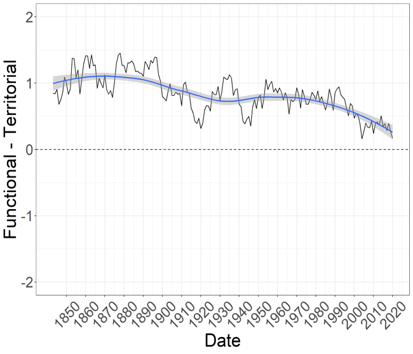
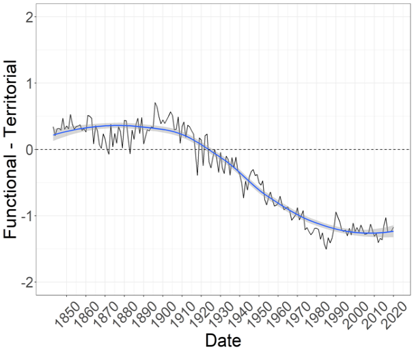
Empirical evidence, including research on the territoriality of cleavages, shows a temporal trend: over time, political conflicts have become less geographically contained and more ideologically distributed (Figure 1). Cleavages today are less about nation versus nation and more about alliances between ideologically aligned groups that span borders (Caramani et al. 2024). This trend indicates a shift in the structure of global conflict, moving away from territorial confrontation and toward functional, identity-based, and ideologically driven struggles. The consequence is that one sees “linkage” between similar actors (parties and movements) and similar groups across world regions (Cox 1997, Morgenstern 2017). Linkage can mean ideological influence, common organizations, financial support or intervention in other countries’ campaigns. Figure 2 shows that some conflicts over inequality are more territorial (when they concerns political and military resources) while some cleavages are less territorial (those on social and cultural rights).
Figure 1 Territoriality of cleavages over time
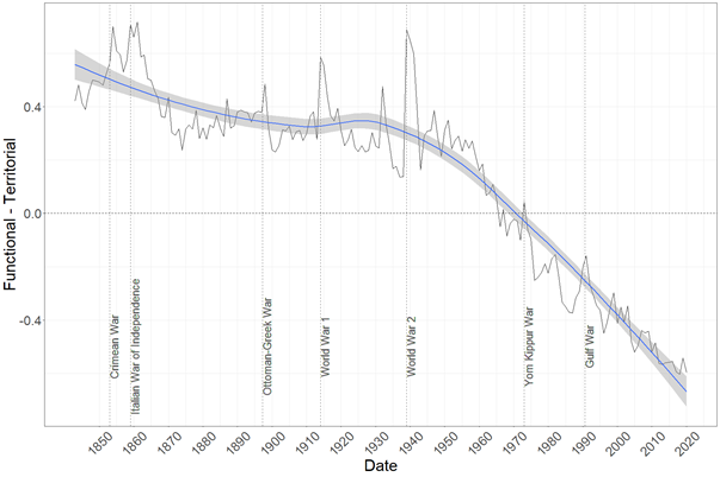
Source: Caramani et al. (2024).
From a transatlantic perspective, this poses a profound challenge. The opposition is not a US–Europe divide (Pontusson 2005, Fabbrini 2007) but rather as a conflict within these societies – between liberal internationalists on the one hand, and nationalist, populist forces on the other. These internal divisions mirror each other across the Atlantic, indicating a shared structural transformation in the politics of liberal democracies.
Question 3: Does the survival of the liberal world order necessitate global ideological dominance?
Addressing this question requires acknowledging its contentious nature as it is not a politically neutral question. Whether the liberal world order requires global ideological dominance depends largely on how one conceptualizes liberalism itself. Defenders of the liberal order, on the one hand, typically argue that liberalism is not an ideology but a procedural framework: a neutral, objective and non-ideological set of rules designed to accommodate diverse ideologies within a system governed by the rule of law. Critics of the liberal order, on the other hand, contend that liberalism is an ideology, namely one that promotes a particular vision of politics, economics, and society, and thereby marginalizes, undermines alternative systems of thought and governance. They see it as a form of domination that restricts other ideologies (and the political and economic systems that are associated with them).
Figure 2 Territoriality of cleavages over time in two areas
Power, military, defence, diplomacy
Gender, health, education
This divergence reflects a deeper contestation over the legitimacy of the liberal order. Who is contesting the liberal world order? Those who challenge it often do so not out of mere opposition to its values, but because they perceive it as a system that structurally disadvantages them. The liberal order, in their view, codifies and legitimizes unequal distributions of power and resources. One finds here again the opposition to globalist, urban, liberal elites (the “citizens of nowhere” or the “Davos-man”). Its institutions and principles are not seen as neutral arenas but mechanisms that entrench existing hierarchies (economic, political, cultural, and geopolitical). There is therefore a contestation of the current distribution of resources between those who are for the status quo and those who request a correction, namely the nationalist-populist actors.
This leads to the emergence of a global cleavage structured around support for or opposition to the liberal order. The contestation is between nationalists and globalists. This division is present in most world polities today. On one side are nationalists, who see the current system as an imposition of Western norms that undermines national sovereignty, cultural identity, and alternative models of governance. On the other side are globalists, who view the liberal order as an essential framework for cooperation, rights protection, and peaceful conflict resolution. Both groups are not bound by national borders. Rather, similar divisions exist within countries, including those that originally built and promoted the liberal order, such as the US, the UK, and France.
Significantly, the most vocal criticisms of liberalism today come from actors within its founding states. In the US, for example, there are deep domestic divisions (to use a euphemism) between those who champion liberal internationalism and those who see it as a threat to national interests. The same applies in many European countries. This internal divisions underscore that the current contestation is not geopolitical in the traditional sense; it is ideological and transnational. This is a cleavage not between countries but within countries in similar ways across the globe.
Nationalists accuse liberalism of masking domination under the guise of neutrality, objectivity and non-ideological independence. Not surprisingly, these accusations often are coupled to caricatures of a distant and cold technocracy. Globalists, in contrast, argue that the alternatives offered – namely nationalist or authoritarian visions of world order – lack institutional coherence and that the brutal, transactional nature of global interactions cannot constitute an “order” but force-based anarchy. These alternatives tend to reject the principles of rule-based governance in favour of a power-centric model, often summarized as “might makes right” (the rule of the strongest). Such a model, by definition, resists formal institutionalization and leads to a more unstable international system. It cannot offer, therefore, an alternative world order but a game of great powers reminiscent of a situation that led to world wars in the 20th century.
Question 4: Are power structures shifting, and if so, how should scholars respond in order to defend or simply better grasp these changes?
Global power structures are undergoing significant transformations, marked not only by shifts in state alliances and geopolitical influence but also by deeper ideological realignments. These changes challenge traditional understandings of power distribution in the international system and require scholars to adapt both their analytical frameworks and normative commitments.
A key indicator of this shift is the fluidity of international alignments. Since the US aligned with Russia, North Korea, and Belarus in voting against a United Nations resolution concerning the war in Ukraine, examples have abounded in the shift away of the US from its post-war allies in North America and Europe.[4] These include the stand-off over tariffs as well as territorial claims in Greenland among others. At the same time, another key indicator is the shifting nature of such alignments. The celebration of the 80th anniversary of the end of World War II in China in early September 2025 included a summit between China, Russia, India and North Korea to redesign a world order very much with the aim to isolate the US.
Such realignments suggest that international positions are increasingly defined not by enduring national positions, but by short-term interests and the ideologies of current administrations.
This reflects a broader trend: the collapse of fixed, country-based orientations and the rise of ideologically contingent foreign policies. The same nation can oscillate between liberal and illiberal stances depending on which party or coalition holds power. For example, the foreign policy direction of the US or Poland can vary drastically from one administration to the next. What would France’s or Turkey’s position be with different administrations? Thus, it is no longer analytically sufficient to speak of “liberal” or “illiberal” countries; rather, of “liberal” and “illiberal” administrations. We must analyse the frequently shifting nature of governing ideologies within states.
How should scholars respond? On one hand, international relations must increasingly account for domestic political shifts and ideological divides within states. They must move awas from inter-national, state-centred and territorial approaches. On the other hand, comparative politics must broaden its scope to incorporate transnational linkages between ideologically aligned actors. Political parties, movements, and even social media networks now engage in cross-border collaboration, influencing each other in ways that transcend traditional geopolitical alignments.
From an academic standpoint, this calls for a shift in focus: from state-centric, territorial models of analysis to networked, ideological, and functional models. Scholars must trace the global trajectories of political ideologies, track the formation of transnational alliances, and analyse how global norms are contested not only between states but within them. New research methodologies – such as cross-national data on ideological networks or the study of international campaign interventions – are increasingly necessary. Both disciplines must see cross-border, group- and ideology-based divisions as more important than territorial (inter-state or state-bounded) divisions. This requires both disciplines to shift away from territorial visions of politics. The conflict today is ideological, as it was often in the past (between the two world wars and during the Cold War) (Caramani 2024).
[1] Central banks in recent decades are an example of non-majoritarian institutions. The judiciary under the principle of the separation of powers is another.
[2] The term “government” emphasizes the non-fully democratic nature of the liberal institutional order.
[3] The term “statistics” is intended here in its original meaning of “science of the state” (Flora 1977).
[4] The resolution, backed by European nations, condemned Russia’s aggression and reaffirmed Ukraine’s territorial integrity. The US opposed this resolution, citing concerns over its language and implications. Instead, the US proposed an alternative resolution calling for an end to the conflict without directly attributing blame to Russia. This alternative passed in the Security Council with support from Russia and China, while traditional US allies like the UK and France abstained.
References
Barber, B. R. (2014). If mayors ruled the world: Dysfunctional nations, rising cities. Yale University Press.
Braudel, F. (1993). A history of civilizations. Penguin.
Burke, Edmund (1774). Speech to the Electors of Bristol (at the Conclusion of the Poll). Various publishers.
Caramani, Daniele. 2017. Will vs. Reason: The Populist and Technocratic Forms of Political Representation and Their Critique to Party Government. American Political Science Review 111(1): 54–67.
Caramani, Daniele (2020). Introduction: The Technocratic Challenge to Technocracy, in Bertsou, E. and Caramani, D. (eds.), The Technocratic Challenge to Democracy. London: Routledge.
Caramani, D. (2024). A Cleavage-Based Conceptualisation of Politicised Global Integration. Journal of European Public Policy (31(10): 3372–95.
Caramani, Daniele, Gurova, Siyana, and Tobias Widmann. 2025. The Evolution of Global Cleavages: A Historical Analysis of Territorial and Functional World Alignments Based on Automated Text Analysis, 1843–2020. Comparative Political Studies 58(7): 1495-1532.
Cox, Gary W. (1997). Making Votes Count: Strategic Coordination in the World’s Electoral Systems. Cambridge: Cambridge University Press.
Fabbrini, Sergio. 2007. Compound Democracies: Why the United States and Europe Are Becoming Similar. Oxford: Oxford University Press.
Flora, P. (1977) Quantitative Historical Sociology: A Trend Report and Bibliography (The Hague: Mouton).
Huntington, S. P. (1997). The clash of civilizations and the remaking of world order. Simon and Schuster.
Hofstede, Geerd and Michael H. Bond (1988). The Confucius Connection: From Cultural Roots to Economic Growth. Organizational Dynamics 16(4): 5‒21.
Inglehart, R., & Welzel, C. (2005). Modernization, cultural change and democracy: The human development sequence. Cambridge University Press.
Keene, E. (2002). Beyond the anarchical society: Grotius, colonialism and order in world politics. Cambridge University Press
Kitschelt, Herbert (1994). The Transformation of European Social Democracy. Cambridge: Cambridge University Press.
Kitschelt, Herbert (1995). The Radical Right in Western Europe: A Comparative Analysis. Ann Arbor: University of Michigan Press.
Madison, James (1787). “Federalist no. 10”. In Hamilton, Alexander, Madison, James and John Jay, The Federalist Papers. Various publishers.
Mair, Peter (2013), Ruling the Void, London: Verso.
Manin, Bernard (1997). The Principles of Representative Government. Cambridge: Cambridge University Press.
Nisbett, Richard E. (2004). The Geography of Thought: How Asian and Westerners Think Differently … and Why. New York: Free Press.
Pitkin, Hanna F. (1967). The Concept of Representation. Berkeley: The University of California Press.
Pontusson, Jonas. 2005. Inequality and Prosperity: Social Europe vs. Liberal America. Ithaca, N.Y.: Cornell University Press.
Rokeach, M. (1973). The nature of human values. Free Press.
Scharpf, Fritz (1999) Governing in Europe: Effective and Democratic? Oxford: Oxford University Press.
Siéyès, Emmanuel Joseph (1789). Vue sur les Moyens d’Exécution Dont les Représentans de la France pourront disposer en 1789 (pp. 1‒39). Paris: unnamed publisher.
Taylor, P. J. (2003). World city network: A global urban analysis. Routledge.
Urbinati, Nadia (2006). Representative Democracy: Principles and Genealogy. Chicago, Ill.: The University of Chicago Press (Introduction and Chapter 1).
Viola, L. A. (2020). The closure of the international system: How institutions create political equalities and hierarchies. Cambridge University Press.
Wallerstein, Immanuel M. (1974). The Modern World-System I: Capitalist Agriculture and the Origins of the European World-Economy in the Sixteenth Century. New York: Academic Press.
Welzel, Christian. 2013. Freedom Rising: Human Empowerment and the Quest for Emancipation. Cambridge: Cambridge University Press.
Funded/Co-funded by the European Union (ERC, GLOBAL, project number 101097740).
Views and opinions expressed are however those of the author(s) only and do not necessarily reflect those of the European Union or the European Research Council. Neither the European Union nor the granting authority can be held responsible for them.