

August 4, 2025
Introduction[1]
The illiberal turn in the world is undeniable (Applebaum 2025; Enyedi et al. 2025; Levitsky and Ziblatt 2018). The Variety of Democracy’s 2025 lists the following facts:
- The level of democracy for the average world citizen in 2025 is back to 1985.
- Nearly 3 out of 4 persons in the world – 72% – now live in autocracies. This is the highest since 1978.
- Liberal democracies (that combine free & fair elections with liberal constraints on executive power and the rule of law) have become the least common regime type in 2024 (16% of world population or 29 countries).[2]
- Almost 40% of the world population, or 3.1. billion people, live in autocratizing countries. Just 6%, or 452 million, live in democratizing countries.
- Freedom of expression is worsening in 44 countries, up from 35 in last year’s report. Freedom of association is declining in 22, and rule of law in 18 countries.
- Elections in 2024 revealed an ambivalent pattern of increased political violence, but also increased pro-democracy mobilization. Few elections shifted the balance from one regime to another.
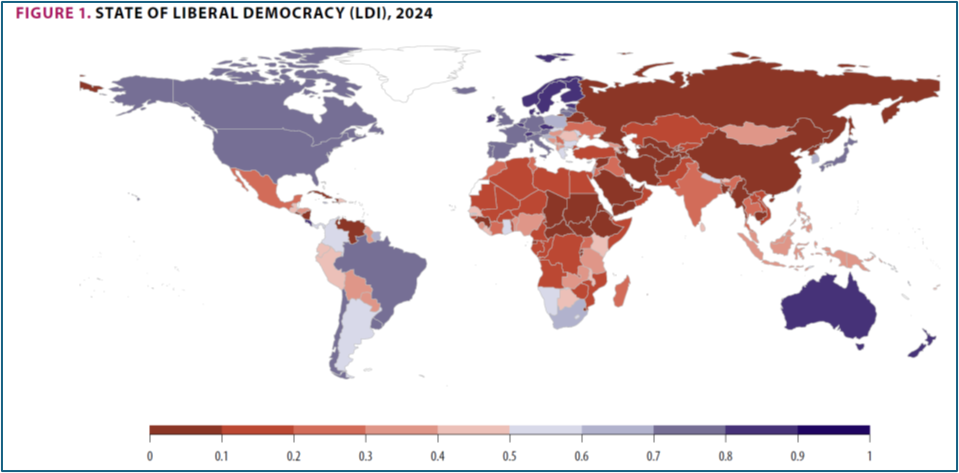
Source: Nord, Marina, David Altman, Fabio Angiolillo, Tiago Fernandes, Ana Good God, and Staffan I. Lindberg. 2025. Democracy Report 2025: 25 Years of Autocratization – Democracy Trumped? University of Gothenburg: V-Dem Institute.
As the V-DEM map suggests the last populous bulwark of liberal democracy is Europe, especially with the United States dropping out of this category in 2025.[3] In this note, I aim to do two things. First, to get a sense of how robust political support for liberal democracy is (or is not) in Europe. And second, to gauge to what extent liberal democracy is tied up with the European Union. My evidence is drawn mostly from the most recent 2024 CHES survey on the positioning of political parties across Europe (Rovny et al. 2025).
Baseline: the rise of the hard right in Europe
Figure 1 shows the electoral strength of hard right or TAN[1] parties relative to other party families since the 1920s for 27 EU countries plus Britain, Iceland, Norway and Switzerland for the years that they are considered democracies (The Economist, February 2025).
Figure 1: The electoral evolution of TAN parties against other party families in Europe
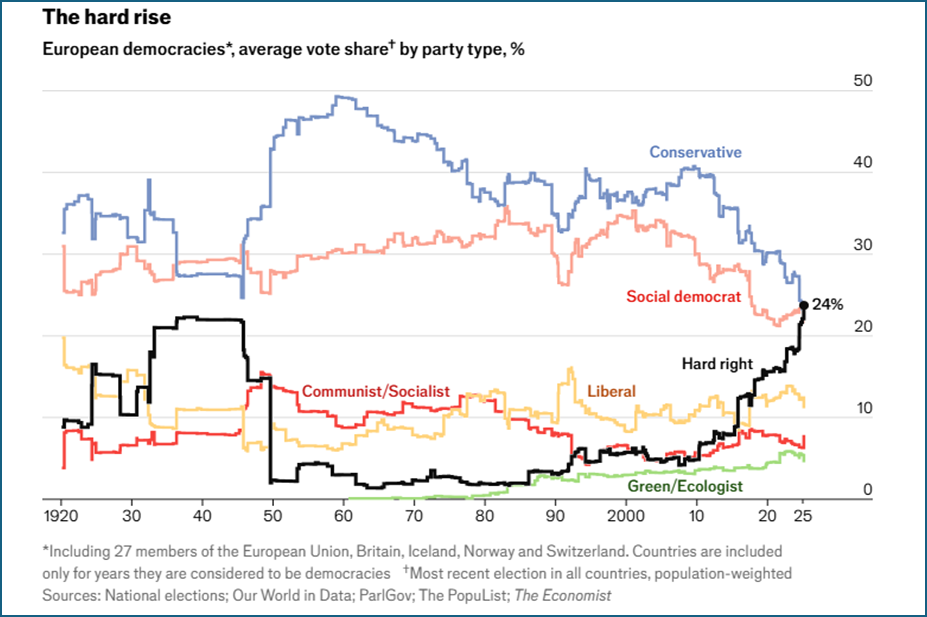
The party political landscape has fragmented into four blocs – each encompassing close to a quarter of the electorate:
- a TAN bloc
- a center/left social democratic bloc
- a Christian democrat/conservative center/right bloc
- A party bloc composed of ideologically diverse parties: Greens, liberals, communist, left socialists.
This distribution of electoral support has decisive consequences for government formation. Imagine that a) TAN parties are uncoalitionable and b) there is no possible majority for either the center/left or center/right fishing in the fourth diverse bloc. In this case, there is only one possible majority coalition, center/left plus center/right. TAN parties form the opposition.
There is wide variation in the strength and position of TAN parties across Europe. In some countries, TAN parties have gained access to levers of power. As of mid-2025 TAN parties are leading governments in Croatia, Finland, Hungary, Italy, the Netherlands, and Slovakia, in a government coalition in Finland, and supporting a minority government in Sweden. TAN parties form the major opposition in Austria, Belgium, Estonia, France, Germany, Latvia, Poland, and Romania. In addition, TAN parties run or co-run 162 cities and 49 regions in sixteen European countries and hold 26% of the seats in the European Parliament. The bottom line is that there is considerable TAN influence at all levels of government across Europe (Albertazzi and McDonnell 2015; Brack and Marié 2024; Broniecki and Høyland 2025; Paxton 2023).
TAN positioning in Europe
Figure 2 and Table 1 compare the positions of TAN parties with those of mainstream parties in 2024 on sociocultural ideology (TAN vs. GAL), support for European integration, accommodation of Russia, illiberalism, and populism. All variables are rescaled 0-10. The boxplots show the median (horizontal line), interquartile range (boxes) and range (excluding outliers) as whiskers for TAN parties on the left and mainstream parties on the right; the table displays mean positions with 95% confidence intervals in brackets.
Figure 2: TAN and mainstream party positions on five issues in 2024
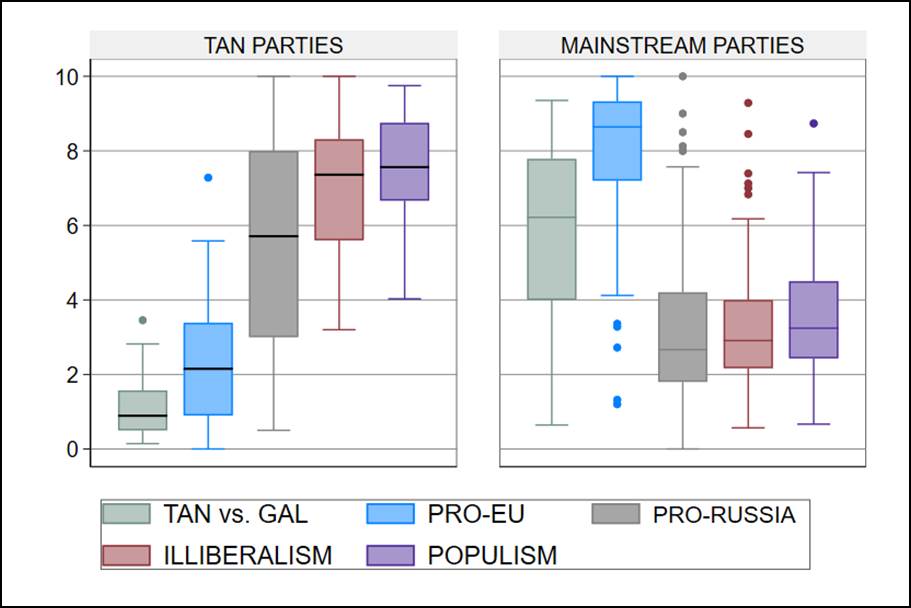
Source: 2024 Chapel Hill expert survey for EU-27+UK; parties with at least 2% of the vote in the most recent national election (Rovny et al. 2025; https://www.chesdata.eu). All issues scaled from 0 to 10. Mainstream = conservative, Christian-democratic, liberal, social-democratic, and green parties.
Table 1: TAN and mainstream parties on five issues in 2024
| TAN vs. GAL IDEOLOGY | PRO-EU | PRO-RUSSIA | ILLIBERALISM | POPULISM | |
| TAN | 1.04 (0.79-1.28) | 2.37 (1.84-2.90) | 5.67 (4.77-6.57) | 6.91 (6.40-7.42) | 7.47 (7.04-7.90) |
| MAINSTREAM | 5.66 (5.28-6.03) | 8.24 (7.97-8.52) | 2.97 (2.65-3.30) | 3.34 (3.09-3.59) | 3.40 (3.17-3.64) |
Source: 2024 Chapel Hill expert survey for EU-27+UK; all issues scaled from 0 to 10. The top row shows the mean position and the second row shows the 95% confidence intervals (in brackets).
Two observations:
- There is a statistically significant and substantively large difference in positioning between TAN and the mainstream broadly defined (because it also includes Green parties). On each of these five issues TAN parties are placed, on average, on the opposite side of the scale from the mainstream. TAN parties really do stand in opposition to the prevailing political norms and values in Europe.
- TAN is a heterogeneous party family. There is considerable variation among parties on several of these issues. TAN does not speak with one voice.
The next sections take a closer look at this heterogeneity.
A subtle shift on Europe?
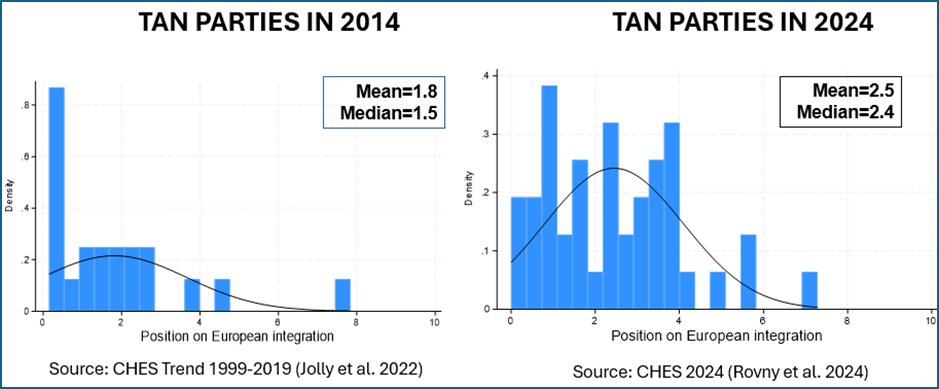
The first thing to note is a subtle shift away from hard Euroskepticism. Figure 3 below shows the distribution of TAN party positions on European integration ten years apart – 2014 and 2024, once again using CHES data. Note that in this ten-year period, the number of TAN parties in this dataset has grown from 16 to 42, in line with Figure 1. However, the mean and median position on European integration as well as the range across the 0-10 scale have shifted slightly towards the neutral point of 5. While in 2014 just one party was located to the right of the neutral point, in 2024 at least five parties were and there is now a sizeable group that appears willing to qualify their opposition to Europe—these are the parties within the 2-5 range.
Figure 3: TAN parties on European integration ten years apart
This is far from saying that TAN has come to accept European integration. Still, there appears a softening of sorts. Why might this have happened? A few plausible mechanisms come to mind.
First, TAN parties’ electoral rise has been fueled by their stance on immigration, which continues to be highly salient in public opinion. So it makes sense for them to focus their ire on immigration rather than Europe. CHES data corroborate this: on a scale from 0 to 10 whereby 0 means “not at all important for the party” and 10 “extremely important”, immigration is at 8.9 with European integration at 5.7.
Second and perhaps more consequentially, TAN parties have come to realize that Europe has its use in constraining immigration at the border.
Third is experience or prospect of participation in government. Government responsibility brings them in contact with issues that are distinct from the big jurisdictional questions of supranationalism and intergovernmentalism. It may make sense for TAN parties to shift their focus from attacks on the existence of the polity to concrete policy decisions.
Interestingly, TAN parties themselves have become more transnational. TAN parties share a similar rhetoric across Europe (and beyond) that attacks prevalent political and social values, including immigration, multiculturalism, open borders, and supranationalism. TAN parties frequently interact: TAN figure heads regularly turn up at conferences or resort to social media to support TAN politicians abroad. Like the national parties in other party families, TAN parties appear willing to pragmatically scale up their game in a multilevel EU polity.
How Euroskepticism shapes TAN positions on Russia
I now examine the effect of TAN response to two salient issues. The first concerns the positions that TAN parties have taken on the war in Ukraine and Russian aggression. Again, I use data from the 2024 Chapel Hill expert survey.
Note that the CHES question on Russian sentiment is soft: “Thinking about the European Union’s relationship with Russia, where do you place each party on its preferred action for European countries to take, from 0= European countries should invest more in defense and security to defend against Russian aggression, to 10=European countries should invest more in trade and diplomacy with Russia to improve relations.” To score 10 on this scale, it is sufficient to declare that one strongly supports prioritizing good trade relations and diplomacy over ramping up defense and security against Russia. This sets a low bar for detecting pro-Russian sentiment since it does not presume alignment with Russia’s foreign policy or domestic goals with Russia or approval of its authoritarian regime.[5]
Figure 4: Euroskepticism and pro-Russian sentiment
Figure 4 reveals a tight connection between Euroskepticism and Russian accommodation both among all parties (R=0.59) and within the TAN family (R=0.59). In a multivariate model that controls for populism and ideology, the effect of a party’s Euroskepticism is substantial: a one-point shift for a TAN party towards Euroskepticism implies a 0.7 warming to Russian accommodation.
TAN parties have had to play their pro-Russia proclivity subtly because the Russian invasion has remained unpopular (Genschel 2025; Moise and Wang 2025). This is where their credibility on Euroskepticism has helped them reframe the discussion from “defending Russia” to “attacking the EU establishment” that is responsible for the costs of the war: higher energy prices, financial support to Ukraine, and pressure on housing and public services due to Ukrainian refugees (Wang and Altiparmakis 2025; Wondreys 2023). Ironically, TAN parties have been at the forefront of accusing the EU of war-mongering, a criticism that hits the EU project—celebrated as a peace project—right in the heart (Fagerholm 2024).
Beyond this, TAN parties are heterogeneous in their position on Russia. Two factors in particular have softened pro-Russian stances: geographical proximity to the war, and government participation (Hooghe et al. 2024).
In all, TAN opposition to Europe’s Russia policy has been surprisingly muted. It has been constrained by a resilient anti-Russian public opinion (except in some countries) and a relatively cohesive stance among the mainstream.
Illiberalism and the European liberal project
A more direct challenge comes from the rise of illiberalism. Figure 5 maps TAN parties’ EU position against their position on illiberalism, measured as an average of items that tap respect for judicial independence and for constraints on executive power.
The first thing to note that TAN parties are bunched in the northwestern corner, where strong illiberalism and strong Euroskepticism meet. This spatial configuration is much more compact than with respect to Russian accommodation. Across Europe, just five parties fall below the neutral point on illiberalism.
The second thing is the affinity between illiberalism and Euroskepticism across all parties (r=0.59); even within the relatively coherent TAN party family, this is still 0.40. The flipside is that the mainstream’s commitment to liberal democracy goes hand-in-hand with support for European integration. In Western Europe, just one of 65 mainstream parties scores above 6 on illiberalism; in Central- and Eastern Europe, six of 66 do.
Figure 5: TAN illiberalism and European integration
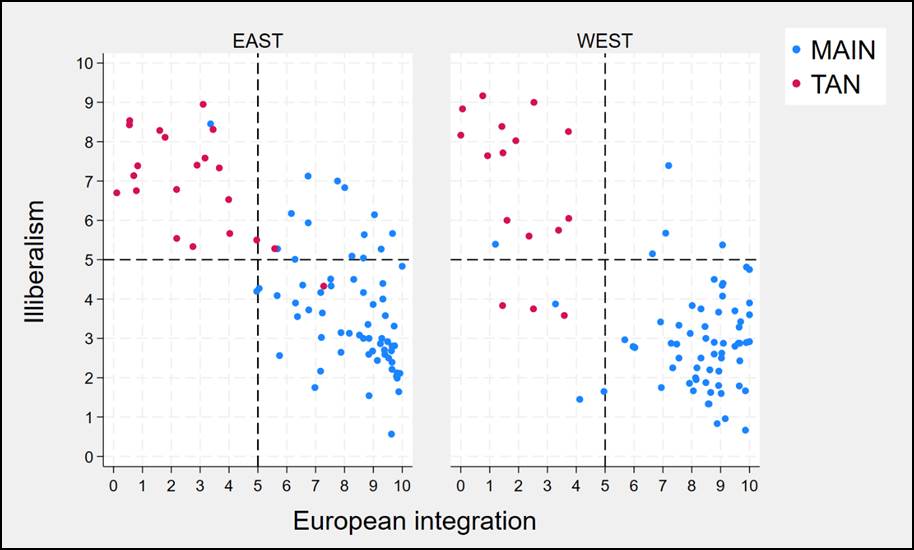
Source: 2024 Chapel Hill expert survey for EU-27+UK; parties with at least 2% of the vote in most recent national election. Illiberalism = (reversed) average of judicial independence, and constraint on executive power (R=0.72).
TAN parties view Europe as a liberal democratic project. No other party family harbors such general opposition against the EU’s liberal democracy. The associations are strongest in Eastern Europe, where the EU remains a beacon of democratic renewal (Koval and Vachudova 2024). And so even while TAN parties may be less determined to oppose the EU as a polity in 2024, they seem inclined to reject its current political regime.
What do we make of this? Is their rejection of illiberalism real or rhetorical? I conclude with two open questions.
What do TAN parties do when they enter power? Do they translate rhetoric into actuality or will they moderate? We have yet to take a systematic look at TAN parties in power. Most of our current knowledge draws from a handful of cases—Hungary and Poland—and it has so far been risky to generalize from these (Enyedi et al. 2025). As the number of cases grows and TAN gains power in more diverse contexts, we will be able to generalize with more confidence.
What one can say is that two institutional factors may help impede illiberal reform. First, PR systems complicate the path to untrammeled power. Thus far the illiberal project has been a minority project in the court of public opinion, and as long as the freedom, fairness and proportionality of elections is broadly preserved, it could be difficult for TAN parties to capture majority control. Beyond that, EU member states are embedded in a dense multilevel network of consensus-oriented decision making, with checks and balances at the EU level. It may require simultaneous TAN supermajorities in various EU institutions to overhaul these. The safeguards against executive aggrandizement, intimidation of opposition or free media, and the erosion of judicial independence are much weaker in the member states or in the many cities or regions where TAN parties already hold government power.
Finally, there is the wild card the United States. TAN parties across Europe are watching closely how the Trump administration is rolling out its playbook of radical illiberalism. What lessons they will draw from that experiment will pretty soon become clearer.
[1] A first draft was presented on June 10, 2025, at the conference “The liberal world order and the future of transatlanticism," held at the RSCAS at the European University Institute, Florence. The author thanks participants for their comments. Also great thanks to my co-PI colleagues with the Chapel Hill Expert survey; the data in this note derive from the 2024 wave of CHES. CHES and the research for this note received financial support from the Advanced European Research Council grant TRANSNATIONAL (#885026).
[2] This count reflects the state of affairs on December 31, 2024.
[3] Outside Europe, V-Dem also gives relatively high LDI scores (>.7 on their 0-1 scale) to Australia, Canada, New Zealand; Brazil, Costa Rica, Chile, Uruguay; Japan; and the USA (2024).
[4] TAN stands for Traditionalist-Authoritarian-Nationalist (Hooghe et al. 2002), which is a more apt description because it captures that these parties tend to hold consistently radical positions on socio-cultural issues. This clarity stands in contrast to their divergent position taking on the economic left/right—from center-left to hard-right (see Rovny et al. 2025 for a recent analysis). TAN parties stand at the conservative extreme of the socio-cultural divide; GAL parties – Green, Alternative, Libertarian—stand at the liberal extreme.
[5] Data collected on party positioning in 2023 – one year after Russia’s invasion of Ukraine—reveals that responses on this general “soft” question correlate highly with more specific questions on willingness to host Ukrainian refugees, accepting higher energy costs, supporting Ukrainian membership to the European Union, or opposing ties with Russia (r=-0.61 to -0.86); among TAN parties, this association is even tighter (r=-0.70 to -0.90) (Hooghe et al. 2024).
REFERENCES
Applebaum, Anne. 2025. Autocracy, Inc: The Dictators Who Want to Run the World. Random House.
Albertazzi, Daniele and Duncan McDonnell. 2015. Populists in Power. Routledge: Abingdon.
Broniecki, Philipp and Bjørn Høyland. 2025. What unites the right in the European Parliament? European Union Politics DOI: 10.1177/14651165251341573.
Enyedi, Zsolt, Petra Guasti, Dean Schafer, Bálint Mikola. 2025. Special Issue: Illiberal politics in Europe: Ideology, policies, and impact. Politics and Governance 13: 10797.
Fagerholm, Andreas. 2024. Sympathy or criticism? The European far left and far right react to Russia’s 2022 invitation of Ukraine. Europe-Asia Studies 76(6): 829–850.
Genschel, Philipp. 2025. Conclusion – external threat and internal divisions: How the war in Ukraine shapes mass politics in the EU. European Union Politics 26(2): 442–450.
Hooghe, Liesbet, Gary Marks, Ryan Bakker, Seth Jolly, Jon Polk, Jan Rovny, Marco Steenbergen, Milada Vachudova. 2024. The Russian threat and the consolidation of the West: How populism and EU-skepticism shape party support for Ukraine. European Union Politics 25(3): 459-482.
Jolly, Seth, Ryan Bakker, Liesbet Hooghe, Gary Marks, Jonathan Polk, Jan Rovny, Marco Steenbergen, Milada Anna Vachudova. 2022. Chapel Expert Survey Trend File, 1999-2019. Electoral Studies, 75.
Koval, Nadiia, and Milada Anna Vachudova. 2024. European Union enlargement and geopolitical power in the face of war. JCMS: Journal of Common Market Studies 62: 135-146.
Levitsky, Steven and Daniel Ziblatt. 2018. How Democracies Die: What History Reveals About Our Future. Viking.
Moise, Alexandru D. and Chendi Wang. 2025. Appeasement or solidarity? Uncovering the drivers of European public opinion on the EU’s foreign policy. European Union Politics 26(2): 418–441.
Nord, Marina, David Altman, Fabio Angiolillo, Tiago Fernandes, Ana Good God, and Staffan I. Lindberg. 2025. Democracy Report 2025: 25 Years of Autocratization – Democracy Trumped? University of Gothenburg: V-Dem Institute.
Paxton, Fred. 2023. Restrained Radicals: Populist Radical Right Parties in Local Government. Cambridge: CUP.
Rovny, Jan, Jonathan Polk, Ryan Bakker, Liesbet Hooghe, Seth Jolly, Gary Marks, Marco Steenbergen, Milada Vachudova. 2025. The 2024 Chapel Hill Expert Survey on Political Party Positioning in Europe: Twenty-Five Years of Party Positional Data. Electoral Studies (accepted July, 2025) [https://www.chesdata.eu]
Wang, Chendi and Argyrios Altiparmakis. 2025. What happened to Putin’s friends? The radical right’s reaction to the Russian invasion on social media. European Union Politics 26(2), 393-417.
Wondreys, Jakub. 2023. Putin’s puppets in the West? The far right’s reaction to the 2022 Russian (re) invasion of Ukraine. Party Politics 31(2), 299-309.